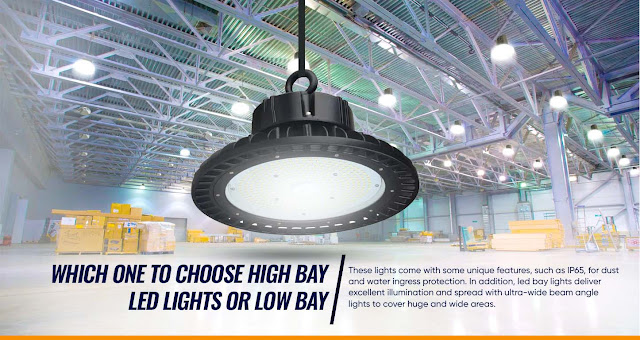
Which one to choose High bay Led lights or Low bay

Which one to choose High bay Led lights or Low bay

Good lighting plays a vital role in increasing or managing the work productivity of the warehouse and business. Therefore, led warehouse lights need to be brighter and energy-efficient. As per your requirements, you need to choose between the high bay led lights and low bay lights. These led lights are primarily installed in spaces like workshops, warehouses, factories, and more. Both the lights come in low to high lumens with good approval ratings and certifications to make it secure for your place. 

These lights come with some unique features, such as IP65, for dust and water ingress protection. In addition, led bay lights deliver excellent illumination and spread with ultra-wide beam angle lights to cover huge and wide areas. 

In this blog, we will help you understand the difference so you can choose the lights according to your needs.       


Difference between both High Bay Led Lights & Low Bay lights 


Many people often get confused when they hear high bay and low bay lights. So, we are going to clear the doubt in this blog. Both the lights have their specialty, and they are used at different locations. 
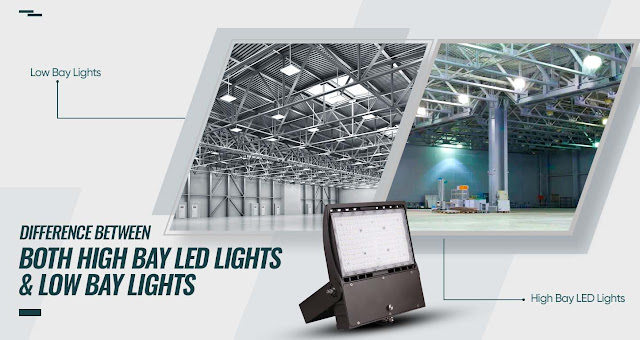

Difference between both High Bay Led Lights & Low Bay lights


High Bay LED Lights:


A high bay light is a light made to use on a ceiling with a 20-40 feet height range from the floor. This Led light is usually found in commercial and industrial spaces. It also comes with a dimming feature which gives the freedom to dim or increase the brightness. High bay LED lights are low maintenance lights and have a long lifespan. It is an easy installation light fixture that is hook mounted on the ceiling. LED warehouse lights are designed in rugged aluminum to make them highly durable from external tampering and damage. It has a minimum of 50000 hours of tested life. It produces high illumination at low energy consumption hence the low maintenance costs. 


Low Bay Lights:


Low bay lights are for brightening lower ceiling lights. Generally, these lights are used for 12 to 20 feet high ceilings in open areas. If you have a taller ceiling than this, you should consider using high bay LED lights. It can be used at various types of ceilings at most retail businesses, public buildings, and homes, but the height of the ceiling matters. It can illuminate any low-height areas with high brightness and energy-efficient lighting. 


Where are low-bay and high-bay LED fixtures used?


High Bay LED lighting is familiar and powerful light to brighten up wide, large spacious areas.  


LED low-bay lighting can illuminate extensive areas though it only works with lower ceilings. 


Here are the locations where both the High-bay and low-bay lights are commonly used:


Manufacturing facilities

Warehouses

Community centers

Indoor car parks

Department stores and other retail spaces

Gymnasiums and sports halls 


Both Low bay and High Bay LED Lights can be suspended from the ceilings and placed to the ceiling by pendants, chains, or hooks. 


Why is it necessary to choose the right lights?


Placing the wrong fixture at the wrong place can be a worry. But, at the same time, the results will definitely get impacted, as the overall space will look less illuminated. For example: if you use low bay lights at a higher height, this will lack the proper brightness and visibility. And the use of high bay LED warehouse lights in a low ceiling will surely overpower the area with too much illumination and consume more energy. This is why choosing the right light according to the ceiling height is necessary for better lighting solutions for your area.

Comments

Popular posts from this blog

LED Tubes: Advantages of LED T8 Light Solutions

Since the launch of LED technology,  The new generation of T8 LED tubes delivers optimum brightness at low power consumption. These tubes are divided into three types. Type A: Ballast Compatible Type B: Not compatible with the ballast  Type A + B: Can work with or without the help of ballast The ballast section controls energy distribution to ensure that the required voltage, current, and waveform are present when a traditional light source like the fluorescent tubes or HID lamps is turned on and operated.  T8 LED bulbs do not require this additional electricity consumption; therefore, eliminating the ballast saves you energy right away because you aren't wasting energy to ballast draw. Each modified fixture uses a few watts less without a ballast. T8 retrofits assist the older fixtures by using the ballast feature to control power consumption and distribute uniform brightness. Usually, the use of ballast has lowered down, giving way to new generation T8 LED tubes. ...

4 Basic Considerations While Choosing Your LED Panel Light

LED light panels are a popular choice for both residential and commercial lighting purposes. They are energy efficient, long-lasting, and versatile, making them an excellent choice for many uses. When choosing LED light panels, there are some basic considerations that you should keep in mind to ensure that you get the best product for your needs. Size and coverage: One of the first things to consider is the size of the LED light panel that you need. You should think about the size of the area that you want to light and choose a panel that is appropriate for that space. You should also consider the beam angle illumination of the panel, as this will affect how much coverage it offers. Brightness: Another important factor to consider is the brightness of the LED light panel. You want to choose a panel that is bright enough to provide sufficient illumination for the area that you are lighting. You should also consider the purpose for which you need the light, as this will help you under...

High Bay LED Lights: Effective Warehouse Lighting Solutions

Finding the right lighting solution for your warehouse can be difficult, and it requires careful planning. LED warehouse lights come with lower maintenance costs and better quality illumination. A lot depends upon warehouse layout and illumination requirements in accordance with the work areas. They are also required for factories, workshops, body shops, and commercial shops. Ceiling height The ceiling needs to be high enough for warehouse lighting solutions. The ideal height should be kept between 15ft-25ft with 21,000 lumens of brightness provided by the LED warehouse lights.  Less heat The difference between traditional lighting and LED warehouse lights is the dissipation of heat. UFO LED high bay lights to generate less heat and also help in lowering the business costs. Durability Factories and warehouses have a rugged environment where heavy machinery and equipment are frequently used. High bay LED lights stand against a busy warehouse's wear and tear for a longer time duratio...